What Entanglement Actually Is
Quantum entanglement is probably the most misunderstood concept in all of physics. Popular science articles describe it as "spooky action at a distance" — Einstein's famous dismissal — and suggest it allows instantaneous communication across the universe. It doesn't. What entanglement actually provides is something more subtle and, for computing, far more useful: correlations between quantum systems that are stronger than anything classically possible.
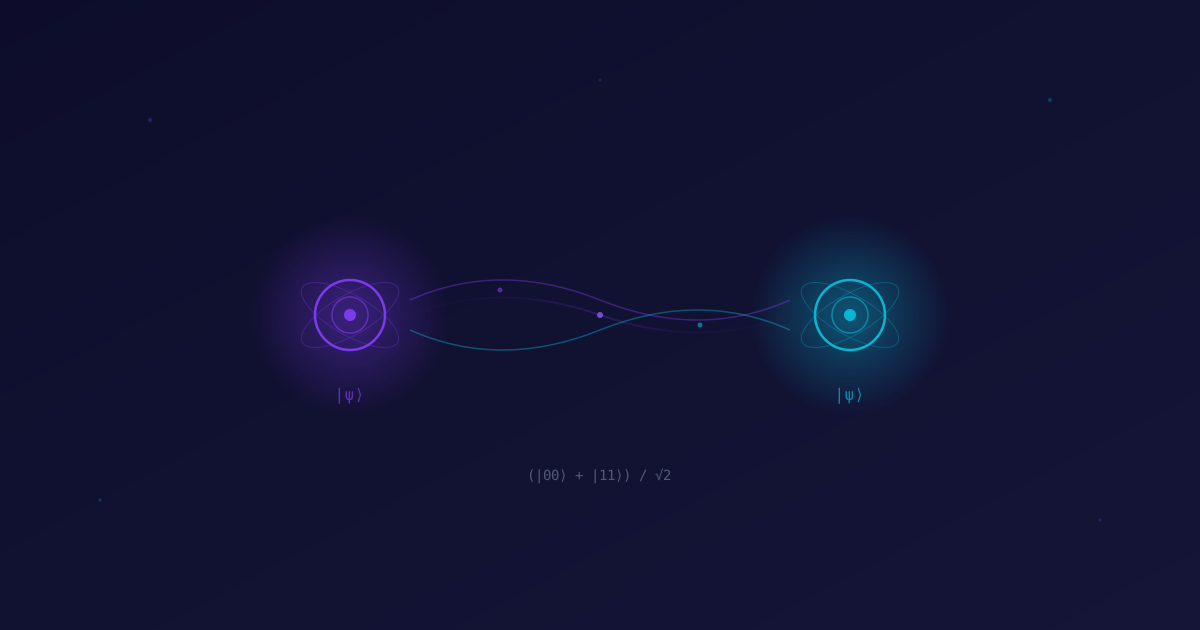
Consider two qubits prepared in the Bell state (|00⟩ + |11⟩)/√2. Before measurement, neither qubit has a definite value — they exist in a superposition. But their values are perfectly correlated: if you measure one and get |0⟩, the other will be |0⟩ too, regardless of the distance between them. This isn't communication — no information travels between the qubits. Instead, the correlation was established when the entangled state was created, and measurement simply reveals it.
The crucial distinction is that these correlations are stronger than any classical correlation. John Bell proved in 1964 that no theory based on local hidden variables — essentially, no classical theory — can reproduce the statistical predictions of quantum mechanics for entangled states. Experiments have confirmed this repeatedly, most definitively in the 2015 loophole-free Bell tests that contributed to the 2022 Nobel Prize in Physics.
Why Entanglement Powers Quantum Computing
Entanglement is not just a curiosity — it's a computational resource. A quantum computer with n qubits can exist in a superposition of 2ⁿ states simultaneously, but superposition alone doesn't give you computational power. You could simulate superposition classically by tracking all 2ⁿ amplitudes (albeit with exponential memory). What you cannot efficiently simulate classically is the pattern of entanglement between qubits.
When qubits are entangled, operations on one qubit instantaneously affect the quantum state of the others. This means a single quantum gate can modify an exponentially large state space in a way that maintains complex correlation patterns. Quantum algorithms exploit this by carefully choreographing entanglement to make correct answers constructively interfere (amplitudes add up) while wrong answers destructively interfere (amplitudes cancel out).
Shor's algorithm for factoring integers is the canonical example. It uses entanglement to create a quantum state encoding all possible results of modular exponentiation simultaneously, then applies the quantum Fourier transform — which relies critically on entanglement — to extract the period of the function, which reveals the prime factors.
Measuring and Quantifying Entanglement
Physicists have developed sophisticated tools to characterize entanglement. For pure states of two qubits, the entanglement entropy — the von Neumann entropy of the reduced density matrix — provides a clean measure. A product state (no entanglement) has entropy zero; a maximally entangled Bell state has entropy one.
For mixed states and many-body systems, the picture is more complex. Measures like concurrence, entanglement of formation, and negativity each capture different aspects of quantum correlations. In many-body physics, the scaling of entanglement entropy with system size distinguishes different phases of matter — area-law scaling typically indicates a gapped ground state, while volume-law scaling suggests a thermalized system.
Understanding these measures isn't just academic. The amount and structure of entanglement in a quantum computation directly relates to its classical simulability. Tensor network methods can efficiently simulate quantum circuits with limited entanglement (low bond dimension), which is why shallow quantum circuits are often classically simulable. The circuits that are hardest to simulate — and thus most likely to demonstrate quantum advantage — are those with high, structured entanglement.
The Entanglement Frontier
Current research is pushing entanglement in several directions. Entanglement distribution over long distances through quantum repeaters could enable a quantum internet. Entanglement-assisted sensing protocols already achieve measurement precision beyond classical limits. And in fundamental physics, the relationship between entanglement and spacetime geometry — crystallized in the ER=EPR conjecture — suggests that entanglement may be the fabric from which space itself emerges.
For quantum computing practitioners, the takeaway is this: entanglement is your primary computational resource, much as energy is the primary resource in thermodynamics. Learning to create, manipulate, and preserve entanglement efficiently is the core skill of quantum algorithm design.