The Market Snapshot
Quantum computing has become a real industry with defined career paths, and it is still a very small one. Both halves of that sentence matter if you are deciding whether to move into it.
Start with the size. The Quantum Economic Development Consortium counted 16,482 pure-play quantum workers worldwide at the end of 2025, an increase of about 2,000 in a year, with 8,261 new job openings posted during that year. For comparison, that entire global workforce would fit inside a single mid-sized tech campus.
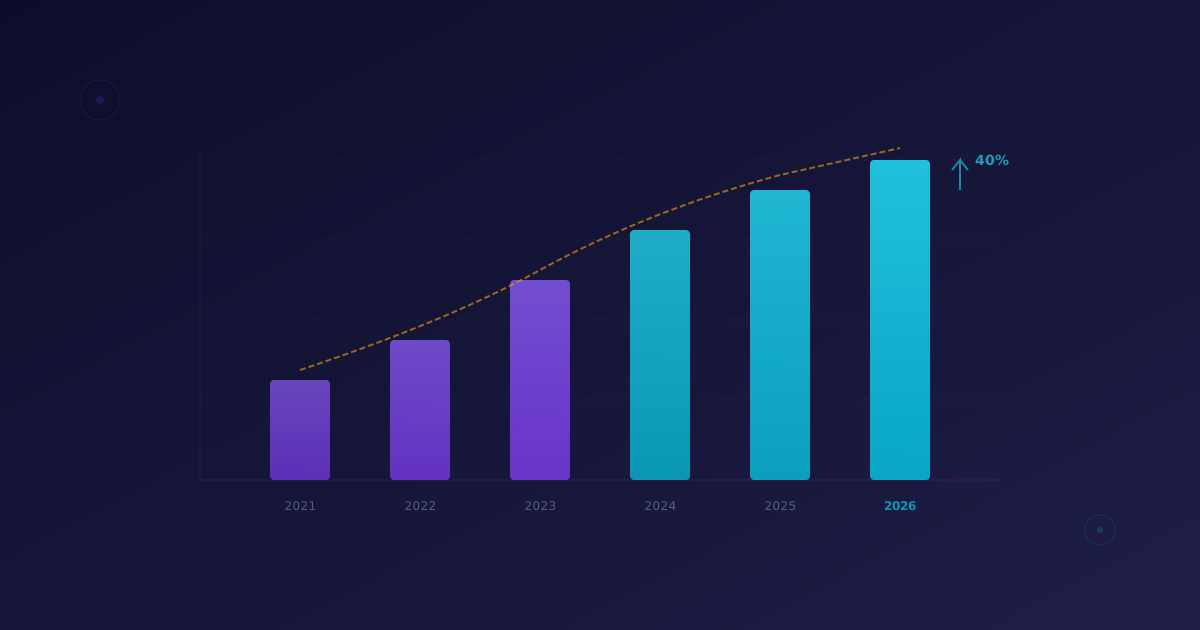
Growth is steady rather than explosive. QED-C recorded an 11% rise in job and internship postings. MIT's Quantum Index Report, drawing on Lightcast labour market data, found that US job postings requiring quantum skills roughly tripled as a share of all postings between 2011 and mid-2024, with the trend since 2021 described as moderate and consistent. If you see a claim of 40% year-on-year growth in quantum jobs, ask where the number came from.
The talent gap is real and frequently misquoted. McKinsey's finding that there is one qualified candidate for every three quantum job openings is genuine, and it was published in 2022. A later McKinsey study showed the gap narrowing: by 2022 roughly two-thirds of open quantum jobs could have been filled by that year's master's graduates, up from about a third in 2021, as the number of universities offering quantum master's programmes went from 29 to 50.
On pay, an analysis of 3,641 quantum job postings published in EPJ Quantum Technology puts the average US quantum salary at $181,491. Industry reporting places senior roles above $200,000 and specialisms such as error correction research in the $130,000 to $200,000 range before equity. Treat any single range with caution, since quantum salaries vary more by employer type than by title. A national lab, a venture-funded startup and a large cloud provider will pay very differently for the same skills.
In-Demand Roles
The job titles have diversified well beyond "quantum physicist".
Quantum software engineers build the compilers, toolchains and frameworks that make hardware usable. Strong Python, familiarity with Qiskit or Cirq, and an understanding of circuit optimisation carry most of the weight here. A physics PhD helps and is no longer the price of entry.
Quantum algorithm researchers design algorithms and prove complexity results. This stays the most academically demanding path, and usually requires a doctorate in physics, mathematics or theoretical computer science. The emphasis has shifted from asymptotic speedups toward algorithms that survive contact with real hardware.
Quantum applications scientists sit between quantum computing and a domain: chemistry, finance, logistics, machine learning. They translate business problems into quantum formulations and judge whether a quantum approach offers anything a classical one doesn't. Breadth matters more than depth, which makes this the most realistic entry point for experienced people changing fields.
Quantum hardware engineers build the physical systems, including superconducting circuits, ion traps, photonic chips and control electronics. Supply here is tightest, and compensation follows.
Error correction and control engineers have grown into a category of their own as the field moves from demonstrations to fault tolerance. Work spans code design, decoder implementation and the FPGA and real-time systems that run them. QED-C also notes a broader shift toward business-oriented roles, which is what industries look like when they start shipping rather than publishing.
Breaking In
Graduate study in physics or computer science with a quantum information focus remains the most common route. Alternative paths have opened: online programmes from MIT xPRO, IBM's Qiskit certification, and a growing set of quantum computing courses give structured entry.
For classical software engineers, start with the frameworks. Qiskit, Cirq and PennyLane all have good documentation. Build things, implement algorithms, contribute to open-source quantum software, and write about what you learn. The community is small enough that visible work gets noticed quickly.
For students, one piece of advice does most of the work: take linear algebra seriously. Quantum computing is linear algebra over complex vector spaces. Once matrix multiplication, eigenvalues, tensor products and unitary transformations are comfortable, the quantum mechanics sits on top of familiar ground.
One finding should shape how you prepare. The same EPJ Quantum Technology analysis reports that around 75% of applicants for quantum roles lack the required skills competency. Read that carefully: the scarcity is in applicants who can do the work, not applicants in general, which means a credible portfolio does more for you than another certificate.
What the Shortage Headlines Leave Out
Career articles about quantum computing tend to stop at the optimistic numbers. Three things deserve equal billing.
The absolute numbers are small. Around 16,500 pure-play jobs worldwide, growing by roughly 2,000 a year, is a narrow market. A shortage of qualified people in a small market still means few positions in any one city, and moving for work is often part of the deal.
Much of the sector runs on funding rather than revenue. Startup investment in quantum reached $12.6 billion in 2025, and the US Commerce Department committed roughly $2 billion under the CHIPS and Science Act, including $1 billion to IBM. That capital is why hiring is happening. It also means hiring plans track funding cycles, and revenues across the pure-play companies remain small against their valuations.
Equity is a large part of many offers, and it is volatile. Listed quantum pure-plays have been among the most volatile stocks in tech, falling harder than the wider sector during 2026 sell-offs. If a package leans on equity, value the cash separately and treat the rest as an option rather than salary. None of this is investment advice, and it is worth asking how any offer is split before you compare it with a classical software role.
The broader employers carry less of this risk. Quantum teams at Google, IBM, Microsoft, Amazon, and the national labs, sit inside organisations that are not funded on the promise of quantum.
Looking Ahead
Published projections point to roughly 250,000 quantum sector jobs by 2030 and 840,000 by 2035, which from today's base implies growth of more than tenfold. Attribution for those figures varies between sources and they come from parties with an interest in the field expanding, so read them as scenarios rather than forecasts.
The direction is easier to trust than the magnitude. Demand for quantum skills has risen steadily for more than a decade, the roles keep broadening away from pure physics, and the work now includes software, error correction, applications and commercial functions. Meanwhile the technology remains pre-commercial for most uses, and vendor targets for fault-tolerant machines cluster around 2029.
For anyone weighing the move, that combination suggests a specific strategy. Build quantum skills alongside a discipline that pays regardless, whether that is software engineering, analytics or a scientific domain. Applications roles reward exactly that pairing, and it leaves you employable on either side of whatever the field does next.
Figures in this article are current as of September 2026 and come from QED-C's State of the Global Quantum Industry 2026, MIT's Quantum Index Report, McKinsey's quantum talent research, and an analysis of 3,641 job postings published in EPJ Quantum Technology. We review this article annually.