What Willow demonstrated
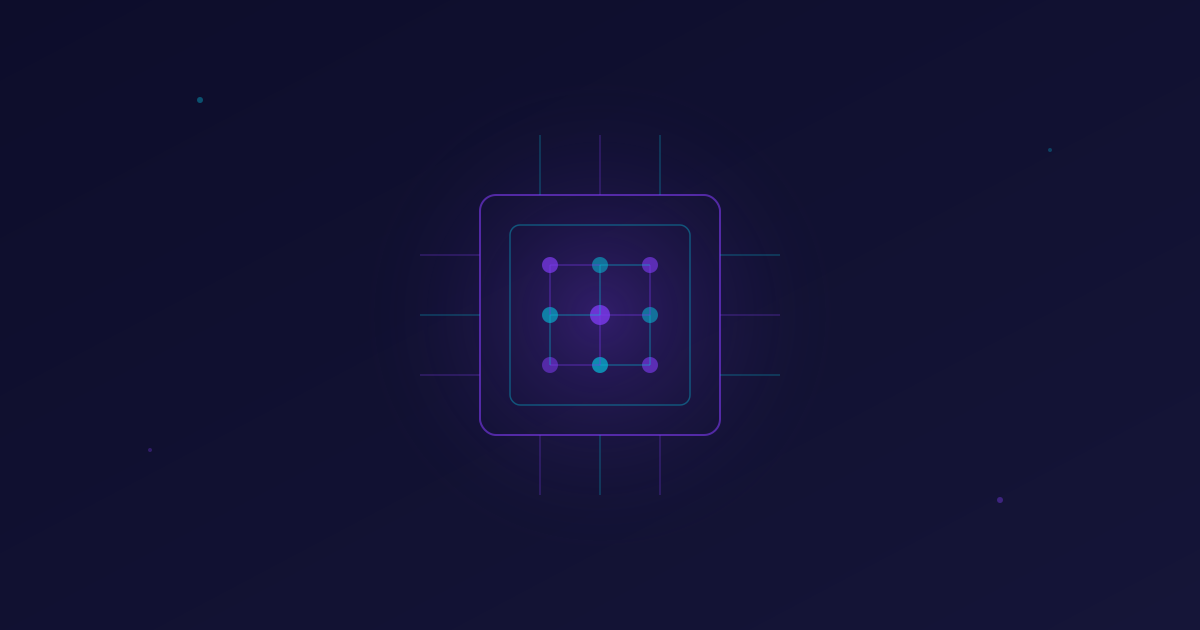
In December 2024, Google Quantum AI published results from Willow, a 105-qubit superconducting processor. By then, 105 qubits was a modest count; IBM's Condor had passed 1,000 qubits a year earlier. The result that mattered came from quantum error correction. On Willow, a logical qubit spread across more physical qubits made fewer errors than one spread across fewer, and the improvement compounded as the code grew.
The numbers are specific. Google ran surface codes at distances 3, 5 and 7. Each step of two in code distance cut the logical error rate by a factor of Λ = 2.14 ± 0.02. The largest code used 101 physical qubits and reached 0.143% error per cycle of error correction. That logical qubit also outlived the best physical qubit on the chip by a factor of 2.4, a condition called beyond breakeven. The full results are in Nature.
Stated plainly, the distance-7 logical qubit makes roughly one error every 700 cycles. Nothing before it came close, and it remains far from the error rates that long algorithms will need. Both halves of that sentence matter for reading the rest of this story.
Why "below threshold" is the milestone
Qubits are fragile. Stray photons, magnetic noise and material defects can flip a qubit's state or destroy its phase. Error correction answers this by encoding one logical qubit across a grid of physical qubits. Repeated syndrome measurements reveal where errors occurred without reading out the encoded information, and a classical decoder decides which corrections to apply.
Every physical qubit added to the grid is also a new place for errors to start. So a bigger code only helps if the hardware's physical error rate sits below a critical threshold. Below it, each increase in code distance suppresses logical errors, which is what Λ > 1 measures. Above it, bigger codes perform worse.
The theory goes back to the mid-1990s, when Peter Shor published the first quantum error-correcting code and several groups proved the threshold theorem. Getting hardware across the line took nearly thirty years. Google's own 2023 experiment on its previous chip, Sycamore, showed a distance-5 code narrowly beating a distance-3 code, with error rates of about 2.9% and 3.0% per cycle. Willow is where the suppression became large, clean and repeatable. Google also ran a real-time decoder at distance 5, with an average latency of 63 microseconds against a 1.1-microsecond cycle, and the code stayed below threshold.
What it leaves open
The surface code experiment built a quantum memory. It preserved one logical qubit over many cycles; it did not compute with logical qubits. Google's roadmap lists a long-lived logical qubit and a gate between two logical qubits as its next milestones, and neither is a small step.
The same paper found a limit worth watching. Google also ran simpler repetition codes, which correct only bit flips, out to distance 29. Their performance was capped by rare correlated error events arriving about once an hour. Errors that hit many qubits at once break the assumption that makes error correction scale, so they will matter more as codes grow.
Scale is the largest open question. Surface codes need many physical qubits per logical qubit, with estimates ranging from hundreds to a few thousand depending on how far below threshold the hardware operates. Decoding also has to keep pace across thousands of codes running in parallel. Google itself has said that reaching cryptographically relevant machines will take orders-of-magnitude improvements in performance and scale.
Where "supremacy" fits
Willow produced two other headline results, and they measure something different.
At launch, Google ran random circuit sampling on Willow in under five minutes and estimated that the Frontier supercomputer would need about 10²⁵ years. That benchmark was built to be hard for classical computers, has no practical use, and its output can't be checked directly.
In October 2025, Google published Quantum Echoes, an algorithm that measures an out-of-time-order correlator. On Willow it ran about 13,000 times faster than the best classical approach on Frontier. Because it measures expectation values, another quantum computer can reproduce the result, which is why Google calls it a verifiable advantage. Google and UC Berkeley also used the technique in a proof-of-concept molecular structure study checked against NMR measurements. Researchers quoted in Nature's coverage remained sceptical of how far the claim extends.
Neither result uses error correction. Both run on physical qubits and show that quantum hardware can beat classical machines on chosen tasks. Error correction is what would eventually let the same hardware run long algorithms, such as Shor's factoring or phase estimation for chemistry, that noisy qubits cannot finish.
How the rest of the field has moved
Willow is no longer the only evidence that error correction works in hardware. It remains the clearest demonstration of exponential suppression in a surface code, and other groups are taking different routes to the same goal.
IBM has moved away from surface codes to quantum low-density parity-check codes, which encode more logical qubits per physical qubit but need longer-range connections on the chip. Its published roadmap runs through intermediate processors to Starling, a fault-tolerant system planned for 2029 with 200 logical qubits running circuits of 100 million gates.
Quantinuum builds trapped-ion machines, which run gates more slowly than superconducting chips but with higher fidelity and connections between any pair of qubits. On its Helios system, researchers have run computations with up to 48 logical qubits under concatenated error-correcting codes, with encoded operations outperforming unencoded ones. A more recent demonstration of its Helix architecture reported logical gate errors about four times lower than the same hardware's physical gates.
Microsoft announced its Majorana 1 topological chip in February 2025. Nature's editors noted alongside the accompanying paper that its results did not represent evidence of the Majorana zero modes the approach depends on, and a formal critique of Microsoft's analysis followed in Nature in 2026. Microsoft maintains its physics is sound. The topological approach has not yet produced error-correction results comparable to Willow's, while Microsoft's logical-qubit work with partners' hardware has continued.
What this means for planning
Willow settled one question: error correction works in real hardware, and it improves with scale when the hardware is good enough. It did not settle how long the engineering will take. Vendor targets for fault-tolerant machines cluster around 2029, and they are targets set by companies with every reason to be ambitious.
One area shouldn't wait for the hardware to arrive. Encrypted data captured today can be stored and decrypted later, and NIST finalised its first post-quantum cryptography standards in August 2024. Migration takes years, so organisations holding long-lived sensitive data have a reason to start now whatever the exact date turns out to be.
The next result to watch is a logical gate between two error-corrected qubits, run below threshold and at a distance large enough to show the same exponential suppression. That would move error correction from protecting quantum information to computing with it.